

How Useful Are You?
And the not-so-secret to being perpetually and especial useful, which you probably don't want to hear but is the key to the good life.

Imagine you’re Salvator Mundi.
The Salvator Mundi. The painting:

Leonardo da Vinci created you around the year 1500. Five hundred and seventeen years later, you sold for $450.3 million.
What a great moment! You’re worth almost half a billion dollars! How self-affirming.
But then you get locked away in storage.
You’ve been hanging around there since. You’re probably worth even more than half a billion by now. And you’re in the most luxuriously comfortable place imaginable where all your physical needs are met. But I bet you feel like crap. I certainly would if I were you, aka Salvator Mundi.
Because you’re not being useful.
Fulfillment Empties Fast Once You’re Useless
A lot of retirees, start-up exit-ees, inheritees, and lottery winners know how it feels to be like Salvator Mundi in storage. They’re worth a lot. Their physical needs are exceeded. And they’re unfulfilled because they’re not doing anything useful.
I got a taste of this feeling in 2014. I was 28. I was a year into my pretirement. I’d traveled all over. I was free. And I had enough Apple and Amazon stock to keep at it for years.
Then, one day, Bing!
The low fuel warning light flashed on my mental dashboard: Approaching emptiness. So soon!? Since I’m not one of those lunatics who takes pride in draining their tank to the last milliliter, I stopped my joyride and rushed to hit the pump to fill up by doing useful things.
This taught me a lesson:
Fulfillment empties out quickly after you stop doing useful things.
(Either that or I have terrible mileage.)
Income Is a Proxy For Usefulness
We tend to use income as a proxy for measuring usefulness. It’s a convenient approximation that society ingrains in us and our status-seeking brains glom onto.
In income’s defense, it’s much easier to gauge than usefulness, and the two are correlated:
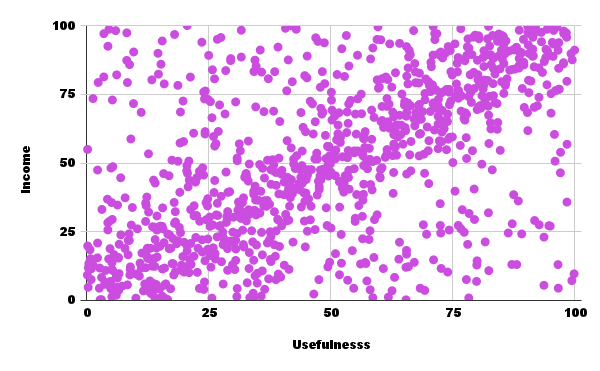
I find Income ≅ Usefulness handy for thinking about my own career and why I’m sitting here writing this on a 9-year-old laptop in a 1-bedroom apartment that will soon have four residents.
The more useful the things you do, the more people will pay you for them. And if you don’t do useful things, you may have to beg people to support your newsletter.
Ahem:
When you stop making enough income to cover your basic needs, you feel the opposite of useful: needy.
Neediness doesn’t only affect bloggers. It affects those who own millions of dollars worth of Bitcoin, Vanguard ETFs, or real estate. They have wealth, but no income, so they start feeling empty and questioning their usefulness. This explains “paycheck envy”, Paul Millerd’s term for the irrational emotion that leads us to prefer steady cash flows over one-time payments.
Uniqueness Matters, Too
Which is worth more, a bottle of water or of Romanée-Conti wine?
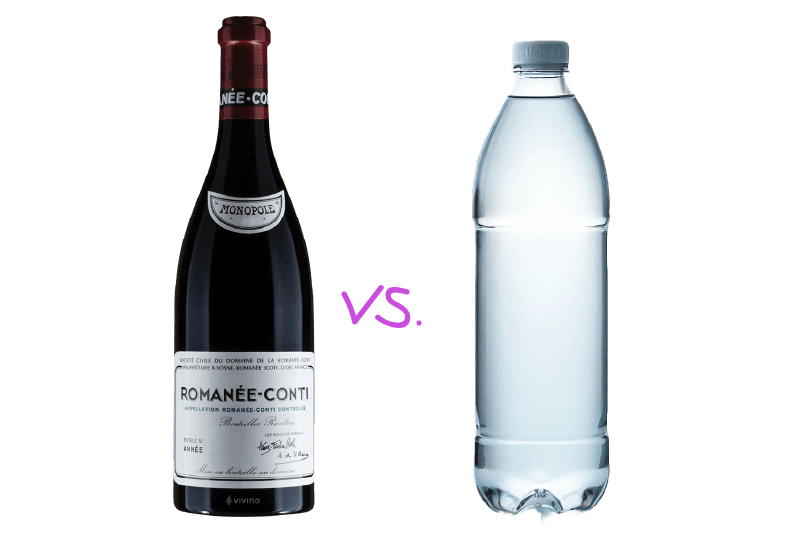
It’s not a trick question. The $26,000 Burgundy wins. But imagine how much 750ml of water would cost if only 6,000 to 8,000 cases were available next year.
So uniqueness1 multiplies the value of usefulness.
This explains the harsh reality of why I struggle to cover my expenses with my writing. My ideas are not as unique and useful as I would like to believe.
Even so, I’m far from feeling miserably unfulfilled from lack of usefulness.
Why?
Thanks to relationships.
Relationships Are Super Unique and Useful
Money approximates usefulness to people you don’t have relationships with. But if you have a good relationship with someone, that correlation goes away.
What is a “good relationship”?
One in which two people are useful to each other.
Good relationships are so effective at fulfilling us because their usefulness is generative. If I pay for a massage, only the masseuse feels useful. But if I give Zac a big hug, both of our usefulness meters tick upward. We’re useful to each other.
Relationships are especially valuable because its uniqueness exceeds that of a bottle of Romanée-Conti. This is why I’d give all my money to get Zac back from a kidnapper. (Don’t get any ideas.)
The feeling of usefulness from good relationships lasts longer than that from income. You don’t even always have to do things to be useful in a good relationship. Simply knowing you’ve got each other’s back is useful in its own right. And being the recipient of the others’ usefulness works, too. Asking a friend for help (the right way) gives them the opportunity to be useful, which makes you useful, and strengthens your useful relationship.
The upshot of all this?
Once your basic needs are met, if your life is full of good relationships, income becomes irrelevant to fulfillment.
Empty-feeling retirees, start-up exitees, and inheritees miss this point.
So did I. “Feel-goody nonsense from a low-income loser,” is what my 28-year-old self would say to all this.
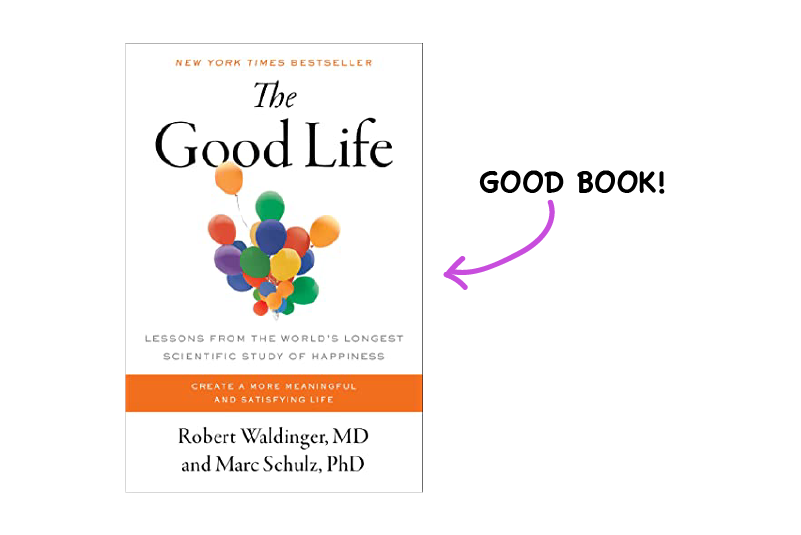
The Good Life: Simple to Grasp, Hard to Embrace
I’d suggest that 28-year-old me read The Good Life by Robert Waldinger and Marc Schulz. They’re the directors of the Harvard Study of Adult Development, the longest scientific study of happiness2 ever conducted.
Since 1938, the study has followed, surveyed, and measured the lives of hundreds of young Bostonian men and their offspring.
Waldinger and Schulz spill the beans in Chapter 1:
If we had to take all eighty-four years of the Harvard Study and boil it down to a single principle for living, one life investment that is supported by similar findings across a wide variety of other studies, it would be this: Good relationships keep us healthier and happier. Period.
“Ok,” snarky 28-year-old Chris would say, “If the answer’s so simple, why’d they have to write a whole book about it?”
Because we refuse to accept it! We’re stuck on the idea that we need a steady stream of strangers’ money and admiration to prove our usefulness and feel fulfilled.
As Waldinger and Schulz write, “We tend to think we know what makes us feel fulfilled, what is good for us, and what is bad for us.” But “one hard truth that we would all do well to accept is that people are terrible at knowing what is good for them.”
“Common sense in this area of life is not so sensible.”
Now go back to imagining you’re Salvator Mundi locked away in some ultra-secure storage room.
Three people come in. They don’t look happy.
You overhear the bad news in their conversation: New AI technology has determined you’re not da Vinci’s. Some guy named Luigi snuck into Leonardo’s studio one day and made you.
Your worth has cratered to single-digit millions. Ouch. The Saudi prince who owned you hawked you off to some businesswoman in Kamloops, British Columbia.
That day turns out to be the best in your life. Better than the day you sold for $450.3 million.
This businesswoman thinks you’re the most fabulous painting in the world. You make her day every time she looks at you. And she shows you off to all her friends who come over.
Life is great. You’re doing what you were made to do. And you’re being uniquely useful to people who care about you, and vice versa.

Shout Out Time!
The wonderful zag-manitarian of the week is the one-and-only Linda Whitney. 👏🎉.
Linda was the first person to jump on the chance to be featured in my Unfollowables interview series. She was also the first person to become a paid subscriber when I moved this newsletter to Substack. I’m inspired by how Linda doesn’t wait around for others before making up her own mind.
Thanks, Linda!
And thank you for reading.
Keep doing exciting things,
Chris
PS: I almost forgot to mention another proxy for usefulness: likes and comments! So if you found this post to be useful, please leave a comment and tap ♡ LIKE.
Grammarians would say there are no degrees of uniqueness. It’s like being dead. Something is either unique or it’s not. My retort: I appreciate your very un-unique opinion and will keep using “unique” in my own most unique way.
Schulz and Waldinger on the word “happy”:
"[I]n lieu of happiness, more nuanced terms like “well-being,” “wellness,” “thriving,” and “flourishing” have become common in the popular psychological literature. We use those terms in this book. Marc is particularly fond of the terms thriving and flourishing because they refer to an active and constant state of becoming, rather than just a mood. But we still use “happiness” at times for the simple reason that this is how people talk about their lives. Nobody says, “How’s your human flourishing?” We say, “Are you happy?” And it’s how, in casual conversation, we both find ourselves talking about our research as well. We talk about health and happiness, meaning and purpose. But we mean eudaimonic happiness. And despite the uncertainty about the word, when people stop to think about what it really means, it’s a natural term.
Chris thank you for keeping me laughing, and making me feel less alone in the stumbling blocks of life. And in todays case, thank you for reminding me to try be usefully unique and keep the relationship fund in a credit friendly state. 🙏 Clear, craftly articulated thinking is a rarity, and it’s a gift you give us in our email box to keep us on the zag:)
Enjoyed this blog. I will share content on my leadership meeting next week. My agency is in the ‘relationship’ business, and this is a great message to share with our volunteers. Rock on!