

I Decoded Tim Ferriss
"True power has one wellspring: true names." Ferriss wrote that. He hasn't found his.

If Taylor Swift has her Swifties, I’m something of a Ferriss-y.
I’ve been following Tim Ferriss’s work, listening to his voice, and even keeping tabs on his love life for… well… longer than I’ve been keeping track of my life, which I started in 2015 thanks to his podcast. A significant chunk of my pretty-awesome lifestyle has Ferriss’s DNA.
But when I listen to Ferriss now, I sometimes wonder whether the master shares his parasocial protege’s enthusiasm. Ferriss’s recent essay, The Self-Help Trap, supports my suspicion. He shares the suboptimal consequences of his obsessive optimization. And in a March podcast with Jim Collins, he opened up about being in a fog about his next move:
What should he do with an 850-page manuscript called The No Book?
How to keep his podcast ahead of the saturating wave?
What should Tim 3.0 or 4.0 even look like?
Then Collins asked Ferriss about his “encodings,” his innate strengths. For a guy who’s spent a Lebron-esque fortune of time and money on therapists, shamans, and coaches, I was surprised by how scattered his answers were.
Tim Ferriss, one of the most successful personal-development gurus alive, can’t clearly name the driver of his success?
This sparked the driver of my own work:
Could I decode Tim Ferriss?
Or is the thought as hubristic as a Swiftie thinking they could write songs for Taylor Swift?
Can Public Data See What Ferriss Can’t?
Ferriss’s fog problem is one I’ve felt for over a decade and have been obsessively (Ferriss-ishly?) building systematic ways through.
My objective: help people decode their wiring and make it legible so they stop scattering their energy and start compounding it with confidence.
The process involves collecting data on an individual from every possible lens, finding patterns, and assembling those into a clear and exciting understanding.
In Ferriss’s case, we’ve got lots of data to work with. Not just breadcrumbs, loaves. More than two decades of books, essays, interviews, podcasts, investments, businesses, critiques, even a fantasy world called COCKPUNCH (quite the data point of a name!).
Of course, this is only public data. So we can’t get the same insight as from my typical process of interviews, assessments, and feedback from people who know him off mic. Even so, Ferriss’s prolificness exposes deeper patterns that filtering or editing can’t cover up. Enough to articulate what drives Ferriss’s success better than he has?
After weeks of analysis, here’s my read.
(For more detail, check out the extended report and appendices that follow.)
Many Labels, But Missing a Name
Over the years, Ferriss has tried to fit his “superpowers” into a long list of labels (Appendix A), each of which covers only a fragment of what makes him formidable. For example:
“Deconstruction” names a technique.
“Meta-learning” names a domain.
“Competitiveness” names part of the fuel.
“Visual acuity” names one perceptual advantage.
“Novelty-seeking” names the search behavior.
“Teacher” names the transmission.
Each label is true. None is complete. Ferriss built a whole mythology around this very problem, and the opportunity that solving it presents. In COCKPUNCH, the multimedia fictional world he created, boys go on a pilgrimage to receive the name that reveals what they are because “True power has one wellspring: true names..”
The Collins interview, and many prior data sources, suggest that Ferriss has yet to have found his own true name. He has found fame and fortune, but if there’s any truth to his mythology, he has yet to find his true power.
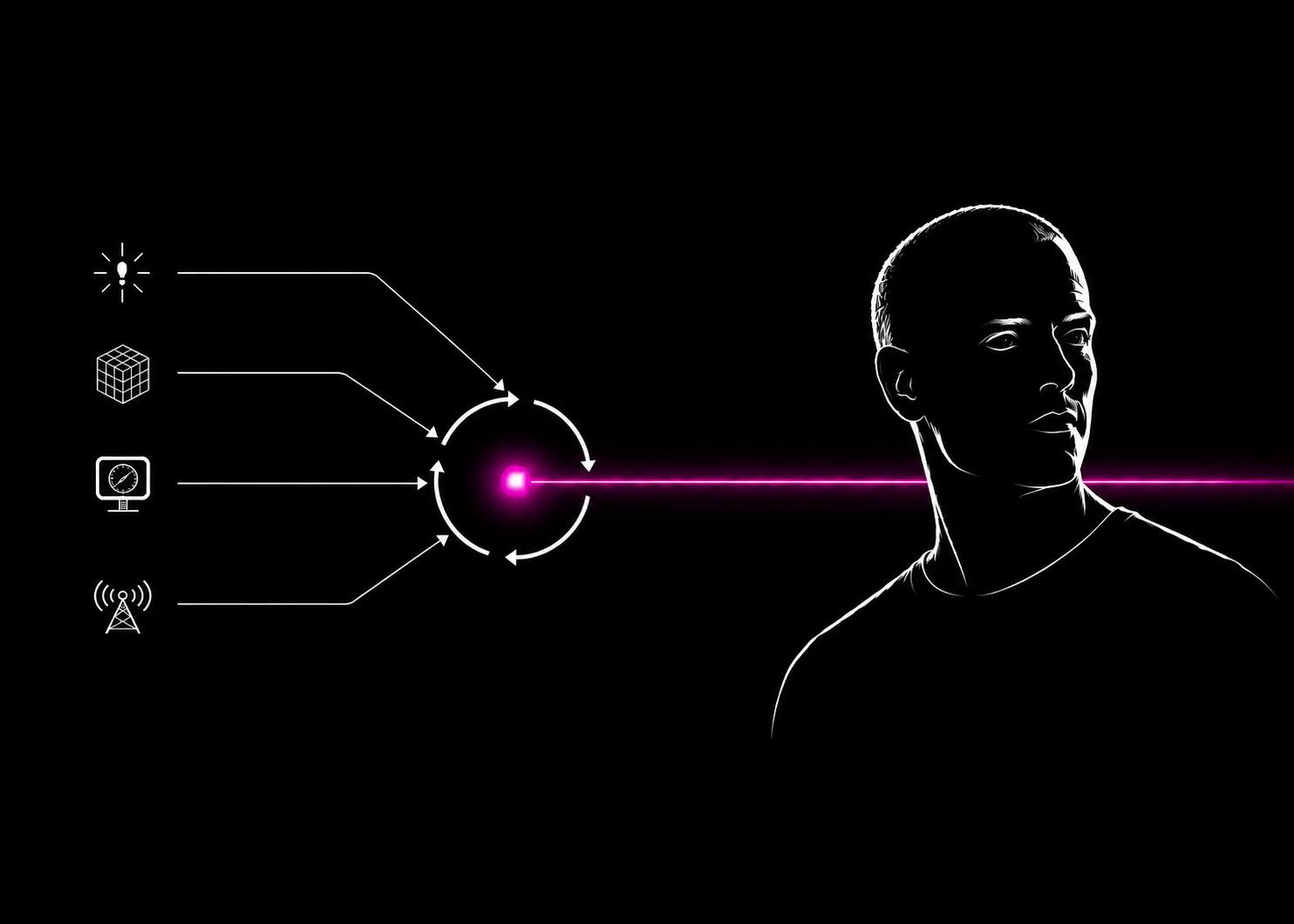
Forget Nouns, What’s the Verb?
Ferriss’s true-name problem may actually have to do with grammar.
He keeps reaching for nouns: lifestyle designer, optimizer, experimentalist, teacher, Tim 3.0, Tim 4.0. Nouns describe roles, identities, chapters. From the outside, these containers look widely varied. Restless, even. But inside the same move keeps repeating. A driver. An action.
What if Ferriss’s true name is not a noun, but a verb?
My read:
Ferriss’s verb is crack.
As in crack a code. Crack a case. Crack open a black box.
Ferriss’s signature move has four phases:
Notice the assumption.
See the hidden structure.
Test it under pressure.
Transmit the result.
First, he notices the assumed rule. Ferriss has described the first phase almost word for word: “If anyone says always, never, should, I pay attention and take note of that... if anything is said in absolutes, I like to stress test.” When it comes to noticing, he has “hypervigilance plus OCD.” Assumptions get under his skin.
Superpower labels he’s given himself like “visual acuity” and “pattern recognition” represent the next phase, seeing the structure. A sketch artist since childhood, he claims he “can probably draw the layout of every restaurant I’ve ever been in.” He has x-ray vision for structure underneath the assumptions he notices.
“Human guinea pig,” “self-experimenter,” deconstruction, competitiveness, and perfectionism are testing under pressure. Ferriss puts skin in the game and pushes hard to test the structures he sees to their limits.
Once the structure has been tested, he transmits it so other people can use it: a book, protocol, question, episode, title, or game. This is where “teacher” and “participatory journalist” fit in, often wrapped in packaging provocative enough to compel people to take a look.
Each phase is powerful in its own right. But the convergence is what makes Ferriss extraordinary.
“Crack” may not be the perfect word. Fine. The name can change. The recurring move doesn’t.
One Move, Many Chapters
Ferriss’s crack pattern shows up all along his many successful life chapters. Appendix B maps 10 of them. Here are a few examples:
Chinese kickboxing. Ferriss found a rule other fighters were underusing, tested it with his body in the ring, and won on structure.
BrainQUICKEN and The 4-Hour Workweek. Ferriss cracked the assumption that a business owner had to be constantly busy, locally bound, and entangled in every operational detail. He turned the crack into a book, a brand, and a new way to design life for people like me.
The podcast. Each episode lets him enter a new domain, find the expert who has already cracked part of it, and use his questions to surface and transmit the structure to millions.
Psychedelic philanthropy. Ferriss helped crack the public assumption that psychedelics were too dangerous or fringe for serious science by funding rigorous research and using his platform to make the case visible.
Ferriss has labeled this frequent moving from one chapter to the next as restlessness and novelty-seeking. But that’s the outside perspective. From the inside, it looks like the completion of his four-phased crack.
His crack loses potency without full control of all four phases. His TV show gave him a crackable format but limited control over testing and transmission. COCKPUNCH let him build, test, and transmit a world, but murky real-world assumptions. And The No Book keeps expanding because the assumption to crack doesn’t appear to be sharp enough yet. (See Appendix C for more examples.)
Then there are the costs of an unnamed drive. When the cracking is aimed at book publishing, lifestyle design, fitness, or learning, it works wonders. When it aims at things better off accepted as they are, it wreaks havoc:
The years of handstand training that ended when his connective tissues cracked instead of the assumptions he was challenging.
The Self-Help Trap essay’s confession that he’s suffered from pointing the drive at himself, using self-improvement as a substitute for actually living. Ferriss named the trend, “sleepwalking through parts of your life with a hammer looking for nails,” but hasn’t named the hammer.
An unnamed drive is an untamed one. It cracks whatever is in front of it. Giving it a name stops the collateral damage and channels the energy toward building something special.
Cracking Through the Fog
If the name of Ferriss’s verb is crack, the question shifts from “What identity comes next?” to “What is worth cracking now?”
Naming the drive doesn’t clear the fog but does give him a clearer view of how he’s wired to move through it, and in which directions to aim. It reframes the doubts he shared with Jim Collins:
What to do about the 850-page No Book? → What is the live assumption to crack?
How to keep his podcast ahead of the saturating wave? → Which conversations crack black boxes nobody else is opening?
What Tim 3.0 or 4.0 should look like? → How can Ferriss deliberately leverage his crack abilities even more?
The last point is where the upside gets exciting. Ferriss has already evolved from solo cracking in his early book and blog days toward collaborative cracking: podcast guests, research institutions, Elan Lee on COYOTE. What would happen if he cracked cracking itself? If he stress tested the structure of his own ability thoroughly enough to teach it, transmit it, and scale it beyond himself?
That is the value of, if not a true name, a more accurate one. It organizes and orients a powerful intrinsic drive. Maybe, as Ferriss wrote in COCKPUNCH, it releases more of one’s true power.
From Hypothesis to True Power
Ferriss’s public record gives us enough to form a serious hypothesis, but not enough to actually harness his true power. The real Innate Edge process would:
Collect first-person and third-person lenses: assessments, deep-dive interviews, work history, and feedback from people who have seen him in action.
Stress-test the full throughline. Is the name of the verb really crack? That’s the “how.” We’d also find the violation (the why) that sparks this drive and the vision (for what) that directs it. Together, these create a focused, guiding story to build on.
Position and put into action. How do we package this self-understanding in Obviously Awesome positioning that the world understands and wants? Then what are the real world stepping stones to test this, collect feedback, and iterate?
I believe this work would set him down a path through the fog with more focus, and confidence, and compounding results.
I also don’t believe he’ll read this.
But you’re reading.
If you’re in a Ferriss-ian fog of uncertainty and feel you’ve got the pieces but they’re not snapping together, try my X-Ray. It has nine questions and takes about 15 to 20 minutes. I’ll personally analyze your answers and send you a report showing where your self-perception may be missing a deeper pattern.
Thanks for reading.
Keep doing exciting things,
Chris
Full Decode File
Extended Tim Ferriss Decode with Appendices.
It includes the extended analysis, chapter mapping, pattern diagnostic, appendices, and source notes.

How are you planning to compel Tim to read it?